Dexaloop › Morywise › The spaced repetition app, explained: FSRS, SM-2 and how to choose
Spaced repetition app
The spaced repetition app, explained: FSRS, SM-2 and how to choose
A spaced repetition app shows each flashcard again just before you are likely to forget it, so you spend less time on cards you already know. Morywise by Dexaloop is a spaced repetition app for iPhone, with an Android version in testing on Google Play. It schedules every card with FSRS-6, a recent version of the open FSRS algorithm.
By Dexaloop, the maker of Morywise · Updated
What is spaced repetition?
Spaced repetition is a way of reviewing in which each fact comes back after a gap, and the gap grows each time you remember it. A card you just learned returns soon. A card you have known for months returns rarely. A spaced repetition app keeps that schedule for every card, so each day you see only the cards that are due.
It rests on three ideas from memory research:
- The forgetting curve. In 1885 Hermann Ebbinghaus tested his own memory of lists and found that forgetting is fast at first and then slows down. Researchers repeated his experiment in 2015 and found a very similar curve.
- Active recall. Trying to bring an answer back from memory, as you do with a flashcard, strengthens it more than reading the answer again.
- Spacing. The same amount of study, spread over days, is remembered longer than when it is crammed into one sitting.
A flashcard app joins the three: it asks you to recall, then uses your answer to decide how long to wait before asking again.
Does spaced repetition work?
Yes, the evidence for spacing is strong. A 2006 review in Psychological Bulletin by Cepeda and colleagues pooled 317 experiments on spaced study and found that the best gap between sessions grows with how long you need to remember. A 2013 review by Dunlosky and colleagues rated ten common study techniques, and only two earned the top rating: practice testing and distributed practice. Highlighting and rereading were rated low.
Two honest limits. Most studies measure groups of learners on lists and texts, so your own results depend on making clear cards and studying most days. And an app cannot make a confusing card easy: one fact per card, in your own words, still matters more than the algorithm.
What is FSRS?
FSRS is an open source scheduling algorithm for flashcards, made by the open-spaced-repetition community; the name is short for "free spaced repetition scheduler". For every card it keeps three numbers:
- Difficulty, from 1 to 10: how hard this card is for you.
- Stability: the gap after which you would still have a 90% chance of recalling it.
- Retrievability: your chance of recalling it right now.
Each answer you give updates those numbers, and the card is scheduled for when your chance of recall falls to the level you are aiming for. In Anki that target is called desired retention, and its default is 90%. FSRS-6 has 21 parameters, fitted to review histories, and lets the shape of the forgetting curve itself be fitted. The project's wiki has since described a newer FSRS-7; Morywise uses FSRS-6.
FSRS vs SM-2: which is better?
FSRS is designed to fit your memory more closely; SM-2 is simpler and easier to predict. SM-2 was written by Piotr Wozniak for SuperMemo in 1987. It reviews a new card after 1 day, then after 6 days, then multiplies each gap by an ease factor that starts at 2.5 and moves with your answers. Anki's long-standing scheduler is based on SM-2, with changes such as four answer buttons instead of six.
Anki's FAQ says FSRS aims to learn your memory patterns and schedule reviews more efficiently than SM-2. The FSRS project tests schedulers in an open benchmark built on review logs from about 10,000 Anki users, scoring how well each one predicts whether you will remember. In Anki, FSRS is an option you turn on in deck options, and it applies to the whole collection.
Fairly put: SM-2 has served flashcard users for decades and still works. FSRS earns its keep when you rate honestly, because it learns from your ratings. Pressing "Easy" on cards you barely knew teaches any scheduler the wrong thing.
Which scheduler does each app use?
Checked 21 November 2026
| App | Scheduler | How the next review is set |
|---|---|---|
| Morywise | FSRS-6 for every card | Your answer updates the card's memory model; two buttons, or four if you prefer |
| Anki desktop and AnkiMobile | Based on SM-2 by default; FSRS as an option since 23.10 | Ease factor with SM-2, or desired retention with FSRS |
| AnkiDroid | The same as Anki; FSRS from version 2.17 | Follows the collection's setting, as in Anki desktop |
| RemNote | Anki SM-2 by default; FSRS version 6 as a beta option | Chosen in its scheduler settings |
| Brainscape | Its own Confidence-Based Repetition | You rate your confidence from 1 to 5 |
| Quizlet | Not named on its App Store listing | Learn is described as adaptive practice; limited rounds without Plus |
How Morywise schedules your cards
FSRS-6, with nothing to set up
Every card, whether you made it, imported it or the AI drafted it, is scheduled with FSRS-6. There are no intervals or ease settings to learn first.
Two buttons or four
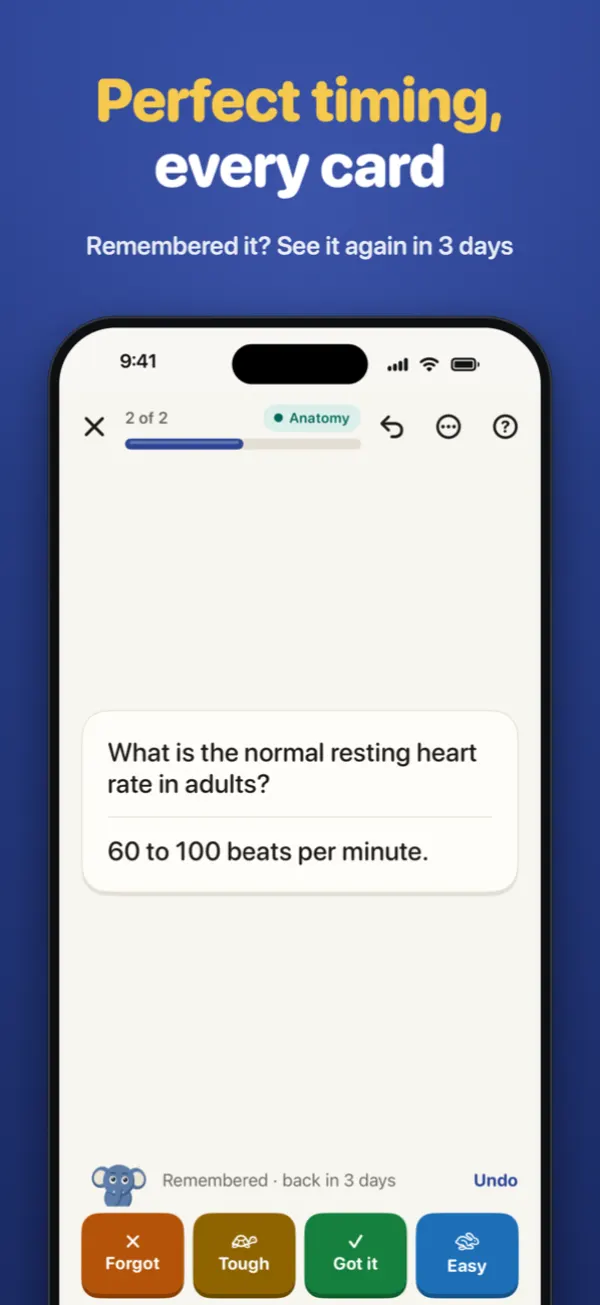
Start with Forgot and Remembered. Turn on four buttons for Forgot, Tough, Got it and Easy. Forgot brings a card back in about 10 minutes.
See when a card returns
After each answer a line says when the card is back, such as "back in 3 days", with Undo beside it. You can also show the next review time on the buttons.
Built for exam dates
Set your exam date for a countdown. Exam mode reviews cards a little more often to keep them fresh, so expect more cards per day.
Coming from Anki? Morywise opens .apkg and .colpkg files with their due dates and full study history, and uses that history for each card's schedule. Review dates can differ a little from Anki's. Export for Anki sends your cards back at any time.
How to start with spaced repetition
About ten minutes
- Pick one subject. A single deck you study every day beats five you open once a week.
- Make small cards. One fact per card. Use cloze ("fill the gap") for definitions and hide parts of a picture for diagrams.
- Or let AI draft them. In Morywise, with Pro or an AI card pack, choose a PDF, a photo of a page or pasted notes. Each draft shows the sentence from your page that backs its answer, and you keep, edit or drop it. The AI card maker is for adults 18 and over.
- Answer honestly. If you had to guess, it was Forgot. The schedule is only as good as your answers.
- Keep new cards modest. Each new card brings reviews over the following days, so add more only when your daily reviews feel easy to finish.
Which spaced repetition app should you use?
- Anki if you want the most control, add-ons and shared decks. It costs nothing on computers and on Android through AnkiDroid; AnkiMobile for iPhone is US$24.99 once and funds the project.
- Morywise if you study mainly on iPhone and want FSRS-6 with a simple start, cards made from your own pages, and your Anki decks brought along. It costs nothing to download; Pro is optional at US$4.99 a month or US$49.99 a year in the US, with a 7-day trial.
- Quizlet if you mostly use sets shared by classmates and want games, and do not need a named spaced repetition scheduler.
We make Morywise, so weigh our view with that in mind. The research above holds whichever app you choose.
Questions people ask
What is FSRS?
FSRS is an open source scheduling algorithm for flashcards, built by the open-spaced-repetition community. For each card it estimates difficulty, stability (the gap at which you would still have a 90% chance of recall) and retrievability (your chance of recalling it now), and fits these to your own review history. Anki added it as an option in version 23.10. Morywise uses FSRS-6 for every card.
Is FSRS better than SM-2?
Anki's FAQ says FSRS aims to learn your memory patterns and schedule reviews more efficiently than SM-2, and the FSRS project publishes an open benchmark built on review logs from about 10,000 Anki users. SM-2 still works and is easy to predict. FSRS helps most when you rate cards honestly, because it learns from those ratings.
Is spaced repetition scientifically proven?
The spacing effect is one of the best studied findings in learning research. A 2006 review in Psychological Bulletin pooled hundreds of experiments on spaced study, and a 2013 review in Psychological Science in the Public Interest rated practice testing and distributed practice as the two most useful of ten common study techniques.
Does Quizlet have spaced repetition?
Yes, on its website. Quizlet's help center describes a Spaced Repetition option in Flashcards: you rate how well you recalled each card, and Quizlet uses that to decide when to show it again. The article says it is currently only on the Quizlet website and does not name the method. Learn, its adaptive quiz mode, is limited without Quizlet Plus.
Is there a spaced repetition app for iPhone that costs nothing to start?
Yes. Morywise costs nothing to download, and cards you make or import from Anki have no limit. Anki's own iPhone app, AnkiMobile, is US$24.99 once on the US App Store, and that price funds Anki's development. Anki desktop and AnkiDroid for Android cost nothing.
How long should I spend on spaced repetition each day?
It depends mostly on how many new cards you add, because each new card brings reviews over the days that follow. Start with a small number of new cards a day, study every day, and add more once your reviews feel easy to finish. In Morywise you set new cards per day and a daily goal for each deck.
Is there a spaced repetition app for Android?
AnkiDroid is a free, open source Anki app for Android with FSRS from version 2.17. Morywise for Android is in a closed test on Google Play, with the same FSRS-6 scheduler as the iPhone app. Joining the test takes two steps, shown on our Android page.
Sources and how we checked
We make Morywise, so read this page with that in mind. Facts about other apps come from their own pages and store listings, on the dates shown. Prices and features change; check the maker's page before you decide. Found something out of date? Email support@dexaloop.com and we will fix it.
- Quizlet Help Center: studying with spaced repetition, checked 21 November 2026
- Murre and Dros (2015), Replication and Analysis of Ebbinghaus' Forgetting Curve, PLOS ONE, checked 21 November 2026
- Cepeda et al. (2006), Distributed practice in verbal recall tasks, Psychological Bulletin (PubMed), checked 21 November 2026
- Association for Psychological Science: Which study strategies make the grade? (Dunlosky et al., 2013), checked 21 November 2026
- FSRS wiki: The Algorithm (open-spaced-repetition), checked 21 November 2026
- SRS benchmark (open-spaced-repetition), checked 21 November 2026
- Anki FAQ: what spaced repetition algorithm does Anki use?, checked 21 November 2026
- Anki manual: deck options (FSRS, desired retention), checked 21 November 2026
- SuperMemo: Algorithm SM-2, checked 21 November 2026
- RemNote Help: the FSRS spaced repetition algorithm, checked 21 November 2026
- Brainscape: the cognitive science behind Brainscape, checked 21 November 2026
- Quizlet on the US App Store, checked 21 November 2026
- Quizlet upgrade page (Plus prices and Learn limits), checked 21 November 2026
- AnkiMobile Flashcards on the US App Store, checked 21 November 2026
- Morywise on the US App Store, checked 21 November 2026
More about choosing a flashcard app
Try Morywise on your own notes.
Make your first deck from a PDF, a photo of a page or your notes, or bring in an Anki deck you already have.